
OUR PROJECTS > FOOD SERVICE l WORKPLACE DESIGN l ASSET MANAGERS l FACILITIES MANAGEMENT l CORPORATE OCCUPIERS
Growing food throughout a building
A large organisation had a goal to create one of the healthiest buildings in the world, with onsite food production playing a central role. Square Mile Farms worked with the architects and fit-out team from an early stage to develop a bespoke growing system spanning the building – from a high-yield indoor Farm in the basement to an edible rooftop garden and productive planting throughout the interior.Together, these spaces grow fresh ingredients for the building's chefs while bringing food, nature and growing into the everyday experience of the people who use the building.

The challenge:
Making food growing
part of the building
The client wanted food production to form an integral part of a building designed around health and wellbeing. That meant thinking about growing at scale, how crops could supply the dining operation and how food production could be integrated into the building.
Square Mile Farms was involved from the early stages, working alongside the architects and fit-out team to develop the growing infrastructure as part of the wider design.
The solution:
Growing from basement
to roof
At the heart of the project is a high-yield indoor Farm in the basement, capable of growing up to 35,000 plants. This is complemented by an edible rooftop garden.
Existing ornamental planters throughout the building were also replaced with edible alternatives, including chillies, citrus trees and nasturtiums. So conventional biophilic planting was tranformed into productive biophilia – planting that contributes to food production.
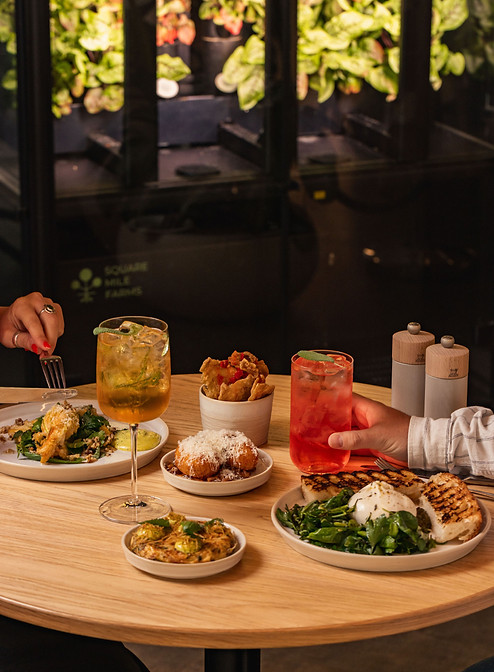
From Farm to kitchen
The indoor Farm operates as part of the building's food service rather than as a standalone sustainability feature.
Square Mile Farms' Urban Farmers work with the chefs to align crop planting with upcoming menus, with fresh produce harvested for just-in-time delivery two to three times a week.
Around 90% of the produce grown is used in the restaurant, while the growing capacity provides yields equivalent to approximately 1.1 acres of traditional farmland.
This close relationship between the growing and dining teams also allows them to experiment with different crops, varieties and flavours according to what the chefs need.

Creating a circular food system
The different growing spaces also connect through a more circular approach to food production.
Organic waste from the Farm and kitchen is composted on the rooftop, with the resulting compost used in the building's rooftop vegetable beds.
This creates a cycle in which food is grown, harvested and eaten within the building, while organic waste contributes to further food production.


Making food part of the experience
On the ground floor, diners are surrounded by edible plants, while many of the leafy ingredients appearing on their plates have been grown within the building. There's even a chef's table within the basement Farm, creating an immersive dining experience surrounded by the crops.

Frequently Asked Questions
Can food growing be incorporated into a building during its design?
Yes. For this project, Square Mile Farms worked with the architects and fit-out team from an early stage to develop a bespoke growing facility as part of the wider building design.
Can an indoor Farm supply a commercial catering operation?
Yes. In this building, Urban Farmers work directly with chefs to plan crops around menus, with produce delivered two to three times a week.
What is edible biophilia?
Edible biophilia combines planting with a practical function. In this project, conventional ornamental planting was replaced in some areas with edible plants including chillies, citrus trees and nasturtiums.
Can onsite food growing help reduce organic waste?
It can form part of a more circular system. Here, organic waste from the Farm and kitchen is composted and the resulting material is used in the rooftop vegetable beds.
Could a bespoke office Farm work in your project?
This type of installation could be relevant if you're:
A food services team looking to integrate large-scale onsite food production directly with your menus and catering operation.
A workplace design team looking to incorporate productive biophilia and food growing into a building from the earliest stages of a project.
An asset manager looking for a distinctive building feature that combines sustainability, wellbeing, food and user experience.
A corporate occupier looking to make health, sustainability and food production a visible part of your workplace.
A facilities team looking for ways to integrate productive planting and circular food initiatives into the operation of a building.

Onsite food production can be much more than a Farmwall or standalone installation.
By involving Square Mile Farms early in the design process, growing can be considered alongside architecture, workplace design, food services and building operations – creating productive spaces that work together from basement to roof.
Talk to Square Mile Farms about integrating food growing into your building.